Arkansas “Don't Do Fescue" is theme of AGFC public campaign
JONESBORO - Tall fescue is a widely used forage crop. It is insect resistant, tolerates poor soil and climatic conditions well and has a long growing season. Unfortunately, tall fescue also has a downside.
With approximately four million acres of pasturelands planted in tall fescue, Arkansas has a great deal of this crop. According to David Long, agricultural liaison with the Arkansas Game and Fish Commission, the agency is working diligently to help the public understand the shortcomings of this type of grass.
"The AGFC has developed a new tool in its effort to educate landowners about the toxic and negative effects of Kentucky 31 Tall Fescue to farm wildlife. A new bumper sticker entitled 'Don't Do Fescue' is now being distributed to agency employees and others interested in spreading the word," Long said. Tall fescue is a common forage grass that has been planted across Arkansas for over 40 years.
Estimates are that about 70 percent-95 percent or 4 million acres of the pasturelands planted with tall fescue in Arkansas are infected with an endophyte fungus. The fungus causes declines in bobwhite quail, cottontail rabbits, grassland songbirds and also limited other game populations such as white-tailed deer and wild turkey.
"The fact that the plant is actually toxic to both domestic livestock and farm wildlife species is accepted by agriculture extension specialists and wildlife biologists alike," Long said. "The plant produces chemicals causing the fescue to have very toxic qualities. The alkaloids are found throughout the plant, but are especially concentrated in the seeds and leaves," he explained.
In cattle, the fungus causes excessive body temperatures, elevated respiratory rates, loss of appetite, body weight loss, lowered fertility rates and abortion of fetuses. Dairy cows often show sharp declines in milk production. Horses are affected also with more aborted fetuses, foaling problems, weak foals and reduced or no milk production. The CES estimates that this endopytic toxin cost American beef producers up to $1 billion a year in lost profits.
"It's very important for private landowners who desire viable wildlife populations on their property to know the effects of planting fescue," Long noted. "Many species of wildlife would directly suffer these same negative effects if they were confined to the pasturelands as are livestock. However, since they are free ranging, they simply avoid the fungus infected fescue pastures, but nevertheless, this results in loss of farm wildlife habitat on these acres. You may have deer and turkey travel through tall-fescue pastures, but they rarely find food sources available they can utilize, since the aggressiveness of the fescue usually results in solid stands of the plant," Long concluded.
The grass is a sod-forming turf with thick matted growth that also limits movement of young bobwhite quail, turkey and cottontail rabbits, provides no nesting habitat for wild turkey or quail, and is extremely poor habitat for many declining grassland species of songbirds. "Bottom line, fungus infected tall-fescue pastures offer little food, cover or nesting habitat to a broad range of farm wildlife," he said.
"Tall fescue has been planted in an estimated 4 million acres of the 5.4 million acres of pasture scattered over the state and for all practical purposes is of no value to farm wildlife. With the widespread establishment of tall fescue pastures, a great loss of wildlife habitat for deer, turkey, quail, cottontails and grassland songbirds has occurred.
Many landowners now recognize this problem and are interested in eliminating tall-fescue on some or all of their acreage. However, many landowners continue to plant tall-fescue, not knowing the detrimental effects it will have to wildlife. (There is an endophyte-free variety of tall fescue available for planting but it is less viable and hardy, and still provides very limited habitat for wildlife.)
We want to educate all landowners regarding this fact because there are other planting options to providing livestock forage and wildlife habitat on their farms," Long explained.
Please help spread the word to landowners "Don't Do Fescue!" by requesting a bumper sticker to place on your vehicle. Especially if they have an interest in managing for wildlife on their farm. For more information contact David Long at 877-972-5438 or dlong@agfc.state.ar.us.
Saturday, May 30, 2009


Wednesday, May 27, 2009
Illinois River Watershed Partnership's appreciation Day set for Saturday June 6, 2009, at Lake Fayetteville

Illinois River Watershed Appreciation Day
Enjoy our watershed, meet new friends, greet old friends ... Bring the Family!
WHEN: June 6 from 2 pm to 7 pm.
WHERE: Lake Fayetteville Veteran’s Pavilion entrance on Zion Rd just east of Lowe's
* Geocaching GIS treasure hunt with USGS water quality experts 2 pm – 4 pm
* Family games, canoe races, volleyball tournament 2 pm – 4 pm
* Free delicious barbecue dinner 4:30 pm
* Recognition of IRWP StreamTeam Volunteers 5 pm
* Free family folk music concert by local artist Marshall T. Mitchell 5:30 pm
Co-sponsors USGS, AWRC, Washington County Environmental Affairs, UA Cooperative Extension Service
www.irwp.org
Tuesday, May 12, 2009
Illinois River Watershed Partnership's board of directors meets 6 to 9 p.m. TODAY
IRWP Board of Directors Meeting
Tuesday, May 12, 6pm – 9pm
Rogers, Nabholz Construction Headquarters
Meanwhile, the Association for Beaver Lake Environment meets at 6 p.m. at the Rogers Public Library.
Please click on image to ENLARGE view of construction site mud being washed down S. Hill Avenue in Fayetteville, Arkansas, on May 11, 2009. Construction machines and dumptrucks put a lot of silt in Northwest Arkansas Streams. Watershed groups must combine forces to increase pressure on all jurisdictions in the region to enforce stormwater regulations to prevent flooding and to protect water quality.

The annual member's meeting of the Association for Beaver Lake Environment is at 6:30 p.m. TODAY (Tuesday, May 12th), at the Rogers Public Library.
We will be electing members for our Board of Directors. Hope to see you there.
IRWP Board of Directors Meeting
Tuesday, May 12, 6pm – 9pm
Rogers, Nabholz Construction Headquarters
Tuesday, May 12, 6pm – 9pm
Rogers, Nabholz Construction Headquarters
Meanwhile, the Association for Beaver Lake Environment meets at 6 p.m. at the Rogers Public Library.
Please click on image to ENLARGE view of construction site mud being washed down S. Hill Avenue in Fayetteville, Arkansas, on May 11, 2009. Construction machines and dumptrucks put a lot of silt in Northwest Arkansas Streams. Watershed groups must combine forces to increase pressure on all jurisdictions in the region to enforce stormwater regulations to prevent flooding and to protect water quality.

The annual member's meeting of the Association for Beaver Lake Environment is at 6:30 p.m. TODAY (Tuesday, May 12th), at the Rogers Public Library.
We will be electing members for our Board of Directors. Hope to see you there.
IRWP Board of Directors Meeting
Tuesday, May 12, 6pm – 9pm
Rogers, Nabholz Construction Headquarters
Saturday, May 2, 2009
FarmToTable theme of today's program in the Rose Garden of the Walton Art Center with renewable-energy lecture at Night Bird bookstore at 2 p.m.
Please click on image to ENLARGE view of OMNI Springfest poster.

Please click on image to ENLARGE view of poster.

Solar Power Struggle
Professor Richard Hutchinson of Louisiana Tech University in Ruston will speak on "The Struggle for the Solar Future" at 2 p.m. on Saturday, May 2, at Nightbird Books on Dickson Street in Fayetteville, Arkansas.
An inquiry into environmental change and the obstacles and opportunities in the path of the renewable energy transition.
Sponsored by OMNI Center for Peace, Justice, and Ecology.

Please click on image to ENLARGE view of poster.

Solar Power Struggle
Professor Richard Hutchinson of Louisiana Tech University in Ruston will speak on "The Struggle for the Solar Future" at 2 p.m. on Saturday, May 2, at Nightbird Books on Dickson Street in Fayetteville, Arkansas.
An inquiry into environmental change and the obstacles and opportunities in the path of the renewable energy transition.
Sponsored by OMNI Center for Peace, Justice, and Ecology.
Thursday, April 23, 2009
April and May events in the Illinois River watershed of Arkansas and Oklahoma
UP
Saturday, April 25 Earth Day at Botanical Gardens 10 am – 2 pm
Join the IRWP and Springdale’s Tree City USA committee by volunteering at our booth. It’s a great way to meet new people and greet old friends!
Monday, April 27 Osage Creek Clean up 9 am – noon
Join the IRWP and Kirksey Middle School 7th graders by helping clean up portions of Osage Creek in Rogers. Clean up crews will meet at the Church at Pinnacle Hills and Home Depot in Rogers at 9 am. Trash bags and gloves provided by Keep Arkansas Beautiful.
May StreamTeam Monitoring
Reminder that May is sampling month for the 2008-2009 IRWP Volunteer StreamTeam Monitoring Project. Please drop your samples off at the AWRC Lab as early in the month as possible and we’ll share yearlong results at our June 6 event.
Many thanks to our IRWP StreamTeam volunteers!
Saturday, May 2 Lake Fayetteville Clean up 9 am – noon
Join the Lake Fayetteville Watershed Partnership in helping clean up Lake Fayetteville. Bring canoes and kayaks, or come ready for a great “clean up walk” around the lake. Meet at the Environmental Study Center at 511 E. Lakeview. RSVP for lunch @sdale.org
Friday and Saturday, May 8-9 Northwest Arkansas Green Expo
Volunteer at the IRWP booth at the Northwest Arkansas Green Expo at the Benton County Fairgrounds. Watershed quiz games for kids & adults with prizes!
Friday 11 am – 5 pm; Saturday 9 am – 3 pm .nwagreenexpo.com
Tuesday, May 12 IRWP Board Meeting 6 pm – 9 pm
Members and guests, come to the 2nd quarter board meeting of the IRWP to be hosted at Nabholz Construction at 3301 N. 2nd Street, Rogers.
Saturday, June 6 Illinois River Watershed Appreciation Day
Come to Lake Fayetteville, 2 pm to 7 pm, for family fun with kid’s games, fishing, geocaching treasure hunt, canoe races, free barbecue and concert.
IRWP Committees
Education Committee: Tuesday, April 28, 11:30 am Washington Co. Environmental Affairs
Membership Committee: Friday, May 1, 9:00 am Lake Fayetteville Pavilion
Finance Committee: Monday, May 4, 3:00 pm 122 Turnberry, Dawn Hill, Siloam Springs
To volunteer email @irwp.org or call (479) 238-4671
Saturday, April 25 Earth Day at Botanical Gardens 10 am – 2 pm
Join the IRWP and Springdale’s Tree City USA committee by volunteering at our booth. It’s a great way to meet new people and greet old friends!
Monday, April 27 Osage Creek Clean up 9 am – noon
Join the IRWP and Kirksey Middle School 7th graders by helping clean up portions of Osage Creek in Rogers. Clean up crews will meet at the Church at Pinnacle Hills and Home Depot in Rogers at 9 am. Trash bags and gloves provided by Keep Arkansas Beautiful.
May StreamTeam Monitoring
Reminder that May is sampling month for the 2008-2009 IRWP Volunteer StreamTeam Monitoring Project. Please drop your samples off at the AWRC Lab as early in the month as possible and we’ll share yearlong results at our June 6 event.
Many thanks to our IRWP StreamTeam volunteers!
Saturday, May 2 Lake Fayetteville Clean up 9 am – noon
Join the Lake Fayetteville Watershed Partnership in helping clean up Lake Fayetteville. Bring canoes and kayaks, or come ready for a great “clean up walk” around the lake. Meet at the Environmental Study Center at 511 E. Lakeview. RSVP for lunch @sdale.org
Friday and Saturday, May 8-9 Northwest Arkansas Green Expo
Volunteer at the IRWP booth at the Northwest Arkansas Green Expo at the Benton County Fairgrounds. Watershed quiz games for kids & adults with prizes!
Friday 11 am – 5 pm; Saturday 9 am – 3 pm .nwagreenexpo.com
Tuesday, May 12 IRWP Board Meeting 6 pm – 9 pm
Members and guests, come to the 2nd quarter board meeting of the IRWP to be hosted at Nabholz Construction at 3301 N. 2nd Street, Rogers.
Saturday, June 6 Illinois River Watershed Appreciation Day
Come to Lake Fayetteville, 2 pm to 7 pm, for family fun with kid’s games, fishing, geocaching treasure hunt, canoe races, free barbecue and concert.
IRWP Committees
Education Committee: Tuesday, April 28, 11:30 am Washington Co. Environmental Affairs
Membership Committee: Friday, May 1, 9:00 am Lake Fayetteville Pavilion
Finance Committee: Monday, May 4, 3:00 pm 122 Turnberry, Dawn Hill, Siloam Springs
To volunteer email @irwp.org or call (479) 238-4671
Wednesday, April 22, 2009
Rogers projects created a lot of environmental damage in 2007. Economic slowdown has slowed process
Please click on images to ENLARGE view of inappropriate treatment of the Illinois River watershed land in Benton County, Arkansas, in October 2007.


Rogers construction has slowed but were stormwater-management efforts completed?
Please click on images to ENLARGE views of red dirt on prairie land and dirt in new streets in Rogers on October 15, 2009.


Benton County officials may have written a good plan but don't expect compliance
Please click on images of typical Benton County stormwater protection efforts along the Osage Creek in the Illinois River watershed on Oct. 15, 2007.


The Morning News
Local News for Northwest Arkansas
Stormwater violations so common in Benton County that this headline sounds like a really bad joke. The lead sentence is misleading.
Benton County Meets Stormwater Requirements
By THE MORNING NEWS
Benton County has met all state and federal stormwater requirements, said Aaron Sadler, Arkansas Department of Environmental Quality spokesman.
The agency sent County Judge Dave Bisbee a letter April 13 that shows the county's 2008 annual report has been reviewed and is compliant. The county is required to submit a stormwater plan report annually but had not done so since 2006, according to state records. Sadler said the plan submitted this year appears to be complete.
The county adopted an "enforcement mechanism" as part of its stormwater plan Jan. 30, according to county reports. Bisbee signed a court order just before the Feb. 1 state deadline.
The stormwater regulations are meant to curb sediment runoff from construction sites in the county's designated area. That area is 3 square miles of the most densely populated unincorporated areas, including Monte Ne and Prairie Creek. Federal regulations already apply to all construction sites disturbing 1 acre or more, and those that are smaller and part of a larger development, stormwater officials have said. However, the county must enforce regulations in the designated area.
The stormwater regulations mostly affect builders.


The Morning News
Local News for Northwest Arkansas
Stormwater violations so common in Benton County that this headline sounds like a really bad joke. The lead sentence is misleading.
Benton County Meets Stormwater Requirements
By THE MORNING NEWS
Benton County has met all state and federal stormwater requirements, said Aaron Sadler, Arkansas Department of Environmental Quality spokesman.
The agency sent County Judge Dave Bisbee a letter April 13 that shows the county's 2008 annual report has been reviewed and is compliant. The county is required to submit a stormwater plan report annually but had not done so since 2006, according to state records. Sadler said the plan submitted this year appears to be complete.
The county adopted an "enforcement mechanism" as part of its stormwater plan Jan. 30, according to county reports. Bisbee signed a court order just before the Feb. 1 state deadline.
The stormwater regulations are meant to curb sediment runoff from construction sites in the county's designated area. That area is 3 square miles of the most densely populated unincorporated areas, including Monte Ne and Prairie Creek. Federal regulations already apply to all construction sites disturbing 1 acre or more, and those that are smaller and part of a larger development, stormwater officials have said. However, the county must enforce regulations in the designated area.
The stormwater regulations mostly affect builders.
Saturday, April 18, 2009
Brown thrashers among the many species to be seen on World Peace Wetland Prairie during Sunday's Earth Day celebration
Please click on image to Enlarge view of one of the many species of birds feeding and picking nesting sites on World Peace Wetland Prairie on April 17, 2009. The elusive brown thrasher is often able to slip into the thickets before a camera can capture its image. But the attraction of scattered brush piles and the excitement of mating season can make them a bit careless.


Sunday, April 12, 2009
Friday, April 10, 2009
Earth Day celebration on April 19, 2009, at World Peace Wetland Prairie
Please click on image to ENLARGE to read details of the poster.

Bird-watchers welcome every day from dawn to dusk!

Bird-watchers welcome every day from dawn to dusk!
Friday, March 27, 2009
Severed limb budding at end. Birds and squirrels and rabbits may eat them

Here is the caption with the photo of limbs burning in Benton County:
Up in smoke:
Benton County employee Harvey Johnson watched a fire at 10791 Stoney Point Road near Lowell on Thursday. The county is burning limbs and trees broken by this winter’s ice storm. Other burn sites are at 9900 Marchant Road in Elm Springs, 21447 Waukesha Road in Siloam Springs and 19941 Bettis Hill Road near War Eagle. Washington County is also burning ice-storm debris on North 40th Street in Springdale. DAVID FRANK DEMPSEY / Benton County Daily Record
If no one in either county had a fireplace or a wood stove, this might seem slightly less ridiculous.
I hope a lot of people who can use firewood or who would collect it and sell it will be at those sites before more is burned and load it up and take it away.
This wood would save people money, reduce air pollution now and save the carbon in these limbs for actual home heating and reduce global climate change (because people with wood stoves and fire places will be buying wood next fall and reducing the tree cover even more in Northwest Arkansas).
Additionally, birds and squirrels are eating buds on those limbs where they are lying. In fact, many large limbs or trunks lying separated from the main trunk for nearly two months are budding right now! So wildlife are having to search a bit more for food, which may be tough for birds facing nesting season.
Burning material with this much value is WRONG.
It is even worse than chipping it all. This is incredibly wasteful and inconsiderate of people and other living things. I am proud to live in Fayetteville where an effort is being made to separate potential firewood for sharing and where the rest is being chipped rather than burned.
This is an example of the need for cross-training and keeping all environmental enforcement under one big umbrella. Apparently, it would be the responsibility of the EPA to see that FEMA's requirements for subsidizing "cleanup" efforts meet environmental guidelines. But I would bet that the EPA has had no input in the cleanup efforts. Otherwise, they would have required sound environmental use of the downed trees and limbs.
And, if there were any budgetary control of FEMA, their pet contractors would be required to compact and compress the loads of loose limbs in their trailers and trucks before claiming a load is full and counting it on the basis of cubic yards.
If you take waste metal to a steel yard or aluminum-recycling facility, you will have your vehicle weighed and then weighed again after the workers pull off what can be recycled. They don't pay more for half-empty truckloads or uncrushed cans that fill a big bag. The scales tell the story.
Should the taxpayers support a system that rewards only selected contractors and ignores the value of the material being destroyed in the pretense of "cleaning up" after a disaster? And requires the hiring of "inspectors" or whatever from different pet companies to make sure the trucks aren't overfilled?
My questions aren't original. I have heard these questions from residents of Fayetteville who are offended by the appearance of poor management and waste.
The city can't ask these questions because the EPA MIGHT look into the problem and FEMA MIGHT delay reimbursement of the city for the work that took a big chunk out of the city's reserve fund.
But somebody has to ask why they don't just weigh the loads and pay and reimburse on the results. My neighbors have asked.
Thursday, March 5, 2009
Thursday, February 26, 2009
Don't let the contractors take all your brushpiles; the birds won't forgive you
Please click on image to ENLARGE view of mockingbird on brushpile at World Peace Wetland Prairie on February 25, 2009,

The more buds you spot on the ends of small limbs the more likely these limbs are the ones to keep on your property if you want plenty of song birds to be in your neighborhood when spring comes. You might also try to convince your neighbors to preserve some similar brushpiles on their property. And urging neighbors to preserve ice-damaged trees on their property also will help.
Many won't understand. But every property owner who keeps a brush pile or resists pressure to cut down a damaged tree can make a difference in the reproductive success of song birds in the coming spring.

The more buds you spot on the ends of small limbs the more likely these limbs are the ones to keep on your property if you want plenty of song birds to be in your neighborhood when spring comes. You might also try to convince your neighbors to preserve some similar brushpiles on their property. And urging neighbors to preserve ice-damaged trees on their property also will help.
Many won't understand. But every property owner who keeps a brush pile or resists pressure to cut down a damaged tree can make a difference in the reproductive success of song birds in the coming spring.
Sunday, February 22, 2009
Read my beak, Bella Vista: Don't oil my eggs, don't shoot my goslings
Please click on image of face of Canada goose to Enlarge and read her bill.


Tuesday, February 17, 2009
Red dirt abominable: West Fayetteville Citizens for Environmental Quality step up against red-dirt farm, limestone quarry
Please click on image to ENLARGE view of dump truck full of red dirt being hauled to construction site in Fayetteville, Arkansas.

Please click on images to ENLARGE photos.

In the photo above, a layer of something approximating topsoil has been spread over red dirt used in trail construction but the chances of a strong enough crop of grass and other natural vegetation taking hold there to prevent erosion on a slope is questionable. Erosion from this site enters Scull Creek, a tributary of the Illiinois River.
In the photo below, red dirt has been built up several feet for the foundation of a strip shopping center in the riparian zone of a tributary of Fayetteville's Town Branch of the West Fork of the White River.

The story linked below is about as good as it gets for coverage of local resident/environmental groups' meetings. However, it is important to note one mistake, a mistake that may explain why comments about red dirt in water-quality discussions never get quoted by local reporters.
Red dirt is misunderstood.
Red dirt is not "rich, red dirt." A soil expert may be able to tell us about "rich, red dirt" someplace on earth. But "red dirt" in Northwest Arkansas is not topsoil even when one sees it on the surface. The natural topsoil has been removed by the mining process of scraping away the soil found above it.
The red dirt found in Northwest Arkansas is non-organic dirt that will not sustain life. It is stone and clay that has been hidden under a layer of organic soil for eons.
"If God had been proud of red dirt, God would not have buried it out of sight," said one Northwest Arkansas natural-resource conservationist speaking about its use on construction sites.
Road-builders and contractors putting up buildings use red dirt for foundation material. Some engineers and planners and developers call red dirt "good dirt" for their purposes. However, red dirt is the opposite of good for growing food or trees or flowering plants. Contractors who spill it beyond the bounds of a foundation quickly hide it under a layer of some type of organic soil that will at least grow a bit of grass.
But that means the possibility of raising a healthy garden or having a tree grow successfully for the long term is impossible forever, or at least until the red dirt is removed! Whole subdivisions may be found with solid red dirt where truly rich almost black topsoil formerly created fertile prairie land with the immense potential for agriculture and wildlife habitat. NOTHING LIVES IN OR ON RED DIRT. Human beings and other living things depend on organic soil for their existence.
Basically, red dirt-covered development sites are as impervious to water as paved lots. Stormwater runs off rapidly because it cannot soak in. The elements that erode from red dirt discolor streams and lakes and rivers and the silt doesn't stop discoloring the water for a long, long time. Native lIfe in streams decreases permanently after such changes in the watershed.
So, please, editors and reporters, let's not use the words "rich" and "red dirt" together. Certainly, people selling lots of red dirt may be enriched. But their product is not "rich" as an agricultural or environmental expert would use the word.
West Fayetteville serious about fighting red-dirt and limestone quarry
Neighbors decry noise, effects of blasting at Big Red Dirt Farm
BY DUSTIN TRACY Northwest Arkansas Times
Posted on Tuesday, February 17, 2009
URL: http://www.nwanews.com/nwat/News/74075/
They're tired of the blasting, they're tired of the noise at all hours of the night and they certainly don't want to see the Big Red Dirt Farm, just off Hamstring Road north of Wedington Drive, converted into a limestone quarry.
That's why members of the West Fayetteville Citizens for Environmental Quality asked Ward 4 Aldermen Shirley Lucas and Sarah Lewis at the group's meeting Monday for the City Council's help in the battle against what has become a noisy, arguably dangerous, big hole in a number of resident's backyard.
"Quarry blasting on the edge of city limits can't be a good thing," Dave Bolen, president of the group, said.
The issue dates back to 2004, when about 50 acres were purchased by the William G. Sweetser Trust and A. Brad Johnson, who began farming the land for its rich, red dirt. Soon, the company decided to harvest the pillars of limestone that ran up through the dirt. Bolen said that was when his headaches started.
"They decided to fire up a rock crusher at 9:30 p.m. on a Saturday night," Bolen told Lucas and Lewis.

Please click on images to ENLARGE photos.

In the photo above, a layer of something approximating topsoil has been spread over red dirt used in trail construction but the chances of a strong enough crop of grass and other natural vegetation taking hold there to prevent erosion on a slope is questionable. Erosion from this site enters Scull Creek, a tributary of the Illiinois River.
In the photo below, red dirt has been built up several feet for the foundation of a strip shopping center in the riparian zone of a tributary of Fayetteville's Town Branch of the West Fork of the White River.

The story linked below is about as good as it gets for coverage of local resident/environmental groups' meetings. However, it is important to note one mistake, a mistake that may explain why comments about red dirt in water-quality discussions never get quoted by local reporters.
Red dirt is misunderstood.
Red dirt is not "rich, red dirt." A soil expert may be able to tell us about "rich, red dirt" someplace on earth. But "red dirt" in Northwest Arkansas is not topsoil even when one sees it on the surface. The natural topsoil has been removed by the mining process of scraping away the soil found above it.
The red dirt found in Northwest Arkansas is non-organic dirt that will not sustain life. It is stone and clay that has been hidden under a layer of organic soil for eons.
"If God had been proud of red dirt, God would not have buried it out of sight," said one Northwest Arkansas natural-resource conservationist speaking about its use on construction sites.
Road-builders and contractors putting up buildings use red dirt for foundation material. Some engineers and planners and developers call red dirt "good dirt" for their purposes. However, red dirt is the opposite of good for growing food or trees or flowering plants. Contractors who spill it beyond the bounds of a foundation quickly hide it under a layer of some type of organic soil that will at least grow a bit of grass.
But that means the possibility of raising a healthy garden or having a tree grow successfully for the long term is impossible forever, or at least until the red dirt is removed! Whole subdivisions may be found with solid red dirt where truly rich almost black topsoil formerly created fertile prairie land with the immense potential for agriculture and wildlife habitat. NOTHING LIVES IN OR ON RED DIRT. Human beings and other living things depend on organic soil for their existence.
Basically, red dirt-covered development sites are as impervious to water as paved lots. Stormwater runs off rapidly because it cannot soak in. The elements that erode from red dirt discolor streams and lakes and rivers and the silt doesn't stop discoloring the water for a long, long time. Native lIfe in streams decreases permanently after such changes in the watershed.
So, please, editors and reporters, let's not use the words "rich" and "red dirt" together. Certainly, people selling lots of red dirt may be enriched. But their product is not "rich" as an agricultural or environmental expert would use the word.
West Fayetteville serious about fighting red-dirt and limestone quarry
Neighbors decry noise, effects of blasting at Big Red Dirt Farm
BY DUSTIN TRACY Northwest Arkansas Times
Posted on Tuesday, February 17, 2009
URL: http://www.nwanews.com/nwat/News/74075/
They're tired of the blasting, they're tired of the noise at all hours of the night and they certainly don't want to see the Big Red Dirt Farm, just off Hamstring Road north of Wedington Drive, converted into a limestone quarry.
That's why members of the West Fayetteville Citizens for Environmental Quality asked Ward 4 Aldermen Shirley Lucas and Sarah Lewis at the group's meeting Monday for the City Council's help in the battle against what has become a noisy, arguably dangerous, big hole in a number of resident's backyard.
"Quarry blasting on the edge of city limits can't be a good thing," Dave Bolen, president of the group, said.
The issue dates back to 2004, when about 50 acres were purchased by the William G. Sweetser Trust and A. Brad Johnson, who began farming the land for its rich, red dirt. Soon, the company decided to harvest the pillars of limestone that ran up through the dirt. Bolen said that was when his headaches started.
"They decided to fire up a rock crusher at 9:30 p.m. on a Saturday night," Bolen told Lucas and Lewis.
Monday, February 16, 2009
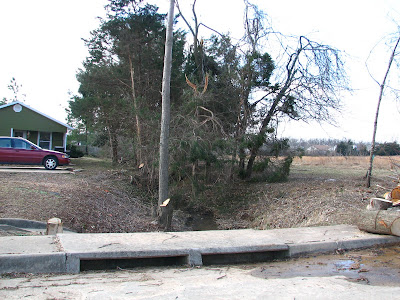
Kitty Creek, a tributary of Mud Creek, which is a tributary of Clear Creek and the Illinois River, in Feb. 2009
Please click on image to Enlarge views of Kitty Creek.



Sunday, February 15, 2009
Kitty Creek a tributary of Mud Creek, which is a tributary of Clear Creek and the Illinois River
Please click on image to ENLARGE photos of Kitty Creek at Stearns Street in Fayetteville, Arkansas, being dredged by city workers in fall 2008. The adjacent neighborhood flooded enough in spring 2008 to panic some of its residents so much that they begged Mayor Coody to dredge it to try to reduce flooding.


Thursday, February 12, 2009
Mud Creek Cleanup set for Saturday, February 21, 2009
Please click on image to Enlarge view of Illinois River. Mud Creek is an urban tributary of Clear Creek, which is a tributary of the Illinois River.
.jpg)
IRWP Mud Creek Clean up Sat. Feb. 21
From: Contact IRWP (contact@irwp.org)
Sent: Thu 2/12/09 12:54 PM
Join the IRWP on Saturday, Feb. 21, from 9 am till 12 noon to learn more about water quality, trees and conservation management from the Arkansas Forestry Commission and help us clean up Mud Creek and enjoy our natural resources!
Meet at the Mud Creek Trail entrance on Front Street just east of College Avenue, south of Joyce Blvd and north of Panera Bread Co. in Fayetteville, Arkansas.
Plastic trash bags and gloves will be provided by the Fayetteville Parks and Recreation Dept.
For details, please email or call 479-238-4671
.jpg)
IRWP Mud Creek Clean up Sat. Feb. 21
From: Contact IRWP (contact@irwp.org)
Sent: Thu 2/12/09 12:54 PM
Join the IRWP on Saturday, Feb. 21, from 9 am till 12 noon to learn more about water quality, trees and conservation management from the Arkansas Forestry Commission and help us clean up Mud Creek and enjoy our natural resources!
Meet at the Mud Creek Trail entrance on Front Street just east of College Avenue, south of Joyce Blvd and north of Panera Bread Co. in Fayetteville, Arkansas.
Plastic trash bags and gloves will be provided by the Fayetteville Parks and Recreation Dept.
For details, please email or call 479-238-4671
Monday, February 2, 2009
Springfed streams support waterfowl during extended periods of subfreezing weather
Please click on image to ENLARGE view of mallards flying into Clabber Creek east of Deane Solamon Road in Fayetteville, Arkansas. This area is downstream from the Wilson Spring area and is called Springwoods area by the developers. Waterfowl depend on springfed streams during periods of subfreezing temperature.


Drawbacks of curb and gutter ignored by most city street standards. Foreclosures offer second chance to do it right
Please click on image to ENLARGE photos for reading sign and seeing detail of January 31, 2009, photos of the Creek Meadow at Springwoods failed development site.

Traditionally, road and lot drainage systems have been designed to convey storm runoff away as quickly as possible to reduce localized ponding. This drainage concept, using curb-gutter-sewer systems, has led to downstream flooding, erosion, water-quality degradation, reduced groundwater recharge and stream baseflow, and aquatic habitat destruction. This paper examines the pros and cons of curb-gutter-sewer systems and qualitatively compares various forms of open ditch -swale drainage alternatives with the conventional curb-gutter-sewer drainage system. These open ditch - swale drainage alternatives not only provide drainage functions but also promote infiltration, trap sediments, and reduce flow velocity along the drainage path. Thus, they can reduce erosion, enhance runoff quality, and increase groundwater recharge. However, they usually require a wider right-of-way than the conventional curb-gutter-sewer systems and may not be suitable for sites with steep topography or erosive soils. For sites that are suitable for the application of these alternative drainage systems, their environment functions make them more attractive than the conventional curb-gutter-sewer system.
Technical study of drawbacks of conventional curb and gutter summarized


Please click on image of storm drain and curb and gutter with a curb cut that brings water OFF the adjacent absorbent wetland to the street and drain opening and thus rapidly to nearby, springfed Clabber Creek in Fayetteville, Arkansas. This fails to recharge the stream in the normal way and destroys the ability of the land to prevent flooding downstream and to cleanse the water. The alternative would be a slightly higher street with curb cuts pouring the water onto the wetland rather than draining the wetland. Such areas obviously should not be developed intensively. Old-fashioned construction of buildings without filling for a base and without a concrete foundation would be the only way anything should be allowed on such prairie soil. Well-engineered modern versions of the simple construction of houses on piers should be designed and required. Old streets in many parts of the city that have existing streetside ditches should be improved only with careful protection of vegetated swales and must include education of the owners and residents of adjacent property on the value of protecting their existing potential "natural stormgardens" rather than seeking to drain their land. Teaching good stewardship of wetland is a city responsibility.
The city's approval of the Creek Meadow at Springwoods subdivision plan was shortsighted and the failure of the developer to complete the project is a blessing because it offers a chance to see that any development that new owners of the foreclosed property propose will be minimized and revised to follow progressive wetland-protection and stormwater-retention concepts.

Traditionally, road and lot drainage systems have been designed to convey storm runoff away as quickly as possible to reduce localized ponding. This drainage concept, using curb-gutter-sewer systems, has led to downstream flooding, erosion, water-quality degradation, reduced groundwater recharge and stream baseflow, and aquatic habitat destruction. This paper examines the pros and cons of curb-gutter-sewer systems and qualitatively compares various forms of open ditch -swale drainage alternatives with the conventional curb-gutter-sewer drainage system. These open ditch - swale drainage alternatives not only provide drainage functions but also promote infiltration, trap sediments, and reduce flow velocity along the drainage path. Thus, they can reduce erosion, enhance runoff quality, and increase groundwater recharge. However, they usually require a wider right-of-way than the conventional curb-gutter-sewer systems and may not be suitable for sites with steep topography or erosive soils. For sites that are suitable for the application of these alternative drainage systems, their environment functions make them more attractive than the conventional curb-gutter-sewer system.
Technical study of drawbacks of conventional curb and gutter summarized


Please click on image of storm drain and curb and gutter with a curb cut that brings water OFF the adjacent absorbent wetland to the street and drain opening and thus rapidly to nearby, springfed Clabber Creek in Fayetteville, Arkansas. This fails to recharge the stream in the normal way and destroys the ability of the land to prevent flooding downstream and to cleanse the water. The alternative would be a slightly higher street with curb cuts pouring the water onto the wetland rather than draining the wetland. Such areas obviously should not be developed intensively. Old-fashioned construction of buildings without filling for a base and without a concrete foundation would be the only way anything should be allowed on such prairie soil. Well-engineered modern versions of the simple construction of houses on piers should be designed and required. Old streets in many parts of the city that have existing streetside ditches should be improved only with careful protection of vegetated swales and must include education of the owners and residents of adjacent property on the value of protecting their existing potential "natural stormgardens" rather than seeking to drain their land. Teaching good stewardship of wetland is a city responsibility.
The city's approval of the Creek Meadow at Springwoods subdivision plan was shortsighted and the failure of the developer to complete the project is a blessing because it offers a chance to see that any development that new owners of the foreclosed property propose will be minimized and revised to follow progressive wetland-protection and stormwater-retention concepts.
Saturday, January 31, 2009
Sunday, January 25, 2009
Illinois River Watershed Partnership plans Jan. 31 stream cleanup with Webelos from Cub Scout Pack 46
Time to start putting some of our material on a site that focuses on where it comes from.
Subscribe to:
Posts (Atom)
